Hermes coder
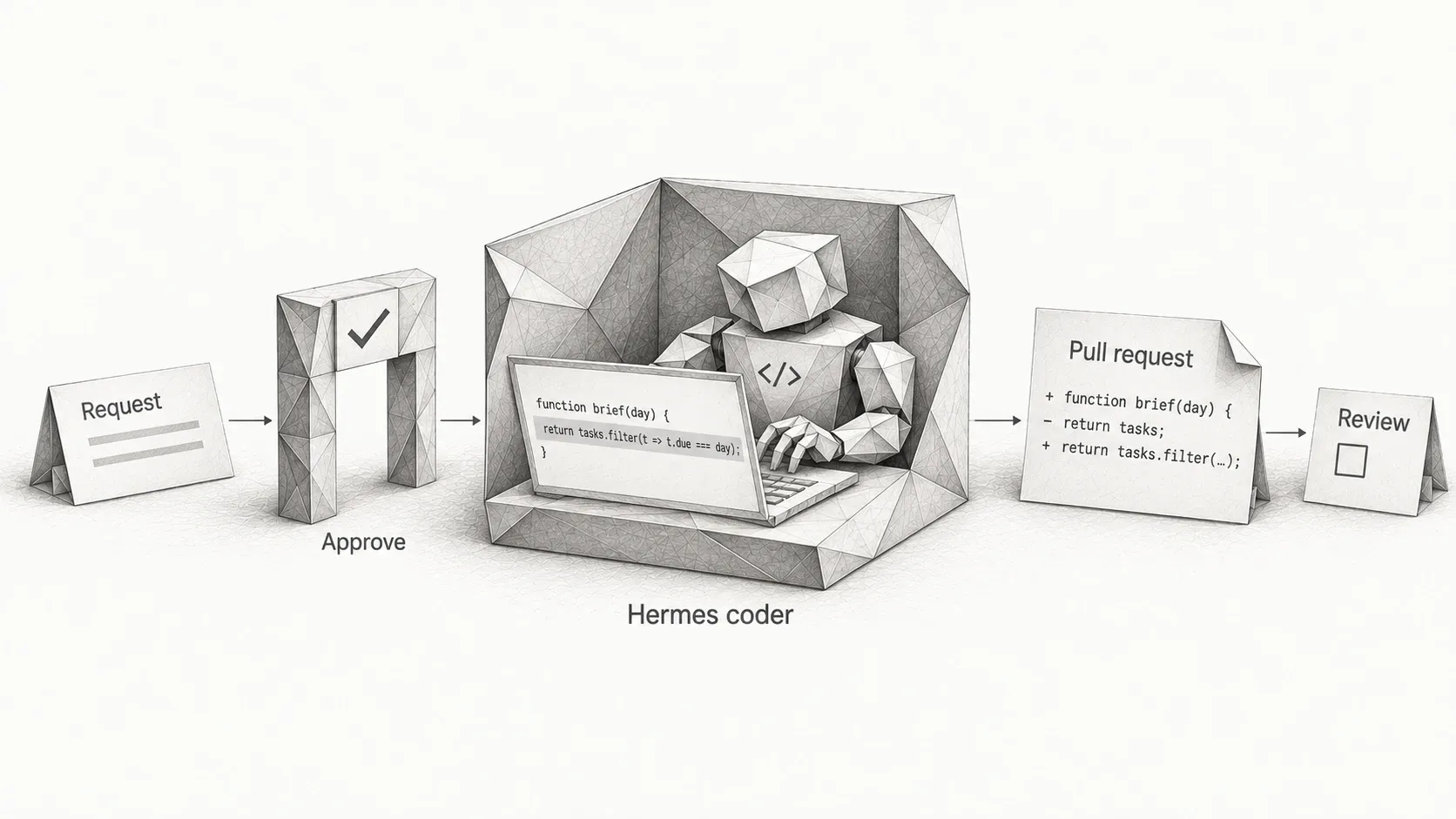
Hermes’s second profile, for code. When I ask, it starts a coding session on my own server, but only after I approve it, and the work ends as a pull request I review and merge. It cannot read my notes.
- Category
- BuildMakes and runs things: code, sites, servers.
- Runtime
- Hermes Agent in a container on my own server, starting Claude Code sessions there
- Trigger
- On demand, from a chat message; I approve each session
- Model
- Claude Opus 5.5
- Adoption
- AssessHow far an agent has made it into how I work, given as a ring, after the Technology Radar.Adopt Part of how I workTrial Runs for real, on probationAssess Being looked at or built, not running regularlyHold Stopped or paused
What it does
Hermes coder is the second profile of the deployment described on the Hermes page: the same container on my own server, the same way in from Telegram, but its own bot and a different job. It dispatches. It never codes.
When I message it a request, it writes a brief in my own words and asks a small MCP server of my own to start a Claude Code session on the same server. Before anything starts, an approval button reaches me in Telegram. Anything but an explicit yes is a no, and that check lives in the server, not in a prompt. Claude Code then does the coding, as a separate user, in one of a few allowed repositories. Hermes coder cannot read my notes.
Why a session, not a chatbot
I could ask a chatbot for a patch and paste it in. I wanted the opposite: the work runs on my server, in a real checkout, with the tools, tests and build of the repository, and it keeps running when my laptop is closed.
Claude Code’s Remote Control puts that session in the Claude app, on my desktop and on my phone. I open it to see what it is doing, answer its questions and steer it, from wherever I am. The chat message kicks it off; the app is where I stay with it.
The session ends as a draft pull request on GitHub. I read the diff and merge it myself, or close it.
What it cannot do
It cannot merge, push or review. Those stay mine, for the same reason Hermes never writes a note: the step that changes something is the step I keep. It cannot read my notes, and nothing starts without my yes.
It sits in Assess because the chain is young and I have started few sessions this way. Whether a brief in my own words beats opening the app and typing one, I do not know yet. The scepticism on the Hermes page applies here with more weight, since this is the profile that leads to code.